• Feed RSS

LinkWithin

Related Posts Plugin for WordPress, Blogger...
 
__._,_.___
Recent Activity:
      
VISIT RUKHSANA FM ONLINE RADIO

http://www.freewebs.com/rukhsanafm
http://www.freewebs.com/rukhsanafm   

http://magicsgifs.blogspot.com
 
***********************************

Enjoy your stay at Rukhsana Group.

Moderators Rukhsana Group:
Aika Rani,Sitara Ansari, Lilly ,A k h t a r,Mumtaz Ali
Contact us at: llolli_bobby@yahoo.com
Aika_Rani@Yahoo.Com
akhtar_khatri2001@yahoo.com
Rukhsana-owner@yahoogroups.com 
**********************************                      
.

__,_._,___

http://www.akshayapatra.org/Centralized1/data/images/4.jpg

It is washed thoroughly on the 2nd floor


http://www.akshayapatra.org/Centralized1/data/images/5.jpg

Washed rice is sent down the chute to the
1st floor


http://www.akshayapatra.org/Centralized1/data/images/6.jpg

Rice pours down into steam heated cauldrons
for cooking. The entire cooking process
takes place on the 1st floor


http://www.akshayapatra.org/Centralized1/data/images/7.jpg

Super heated steam is used
to cook food instead of flame.


http://www.akshayapatra.org/Centralized1/data/images/8.jpg

When cooking is finished, it is
loaded into trolleys


http://www.akshayapatra.org/Centralized1/data/images/9.jpg

Cooked rice is sent down the chute
to the ground floor


http://www.akshayapatra.org/Centralized1/data/images/10.jpg

It flows down the pipe into containers


http://www.akshayapatra.org/Centralized1/data/images/11.jpg

Piping hot rice on its way to being
loaded into food vans. Around
6000 kilosof rice are cooked daily
in each kitchen.


http://www.akshayapatra.org/Centralized1/data/images/12.jpg

Food materials in Kitchen


http://www.akshayapatra.org/Centralized1/data/images/13.jpg

Stock in the kitchen


http://www.akshayapatra.org/Centralized1/data/images/14.jpg

Washed dal and vegetables flows
down the chute into sambar cauldron on
the 1st floor.


http://www.akshayapatra.org/Centralized1/data/images/15.jpg

Vegetables and dal ready to be cooked


http://www.akshayapatra.org/Centralized1/data/images/16.jpg

Sambar being cooked on the first floor


http://www.akshayapatra.org/Centralized1/data/images/17.jpg

Cooked sambar is packed and sent to the
food vans to be loaded.


http://www.akshayapatra.org/Centralized1/data/images/18.jpg

Chapati dough is mixed


http://www.akshayapatra.org/Centralized1/data/images/19.jpg

Heavy rollers flatten the dough into
thin sheets


http://www.akshayapatra.org/Centralized1/data/images/20.jpg

Dough is cut into the classic round shape


http://www.akshayapatra.org/Centralized1/data/images/21.jpg

Making chapatti


http://www.akshayapatra.org/Centralized1/data/images/22.jpg

Collecting all the chapattis


http://www.akshayapatra.org/Centralized1/data/images/24.jpg

Transporting akshayapatra food through bus


http://www.akshayapatra.org/Centralized1/data/images/25.jpg

Happy Kids


http://www.akshayapatra.org/Centralized1/data/images/26.jpg

Students benifited from akshayapatra


http://images2.fanpop.com/image/photos/10900000/Animated-Aum-hinduism-10922697-164-172.gif
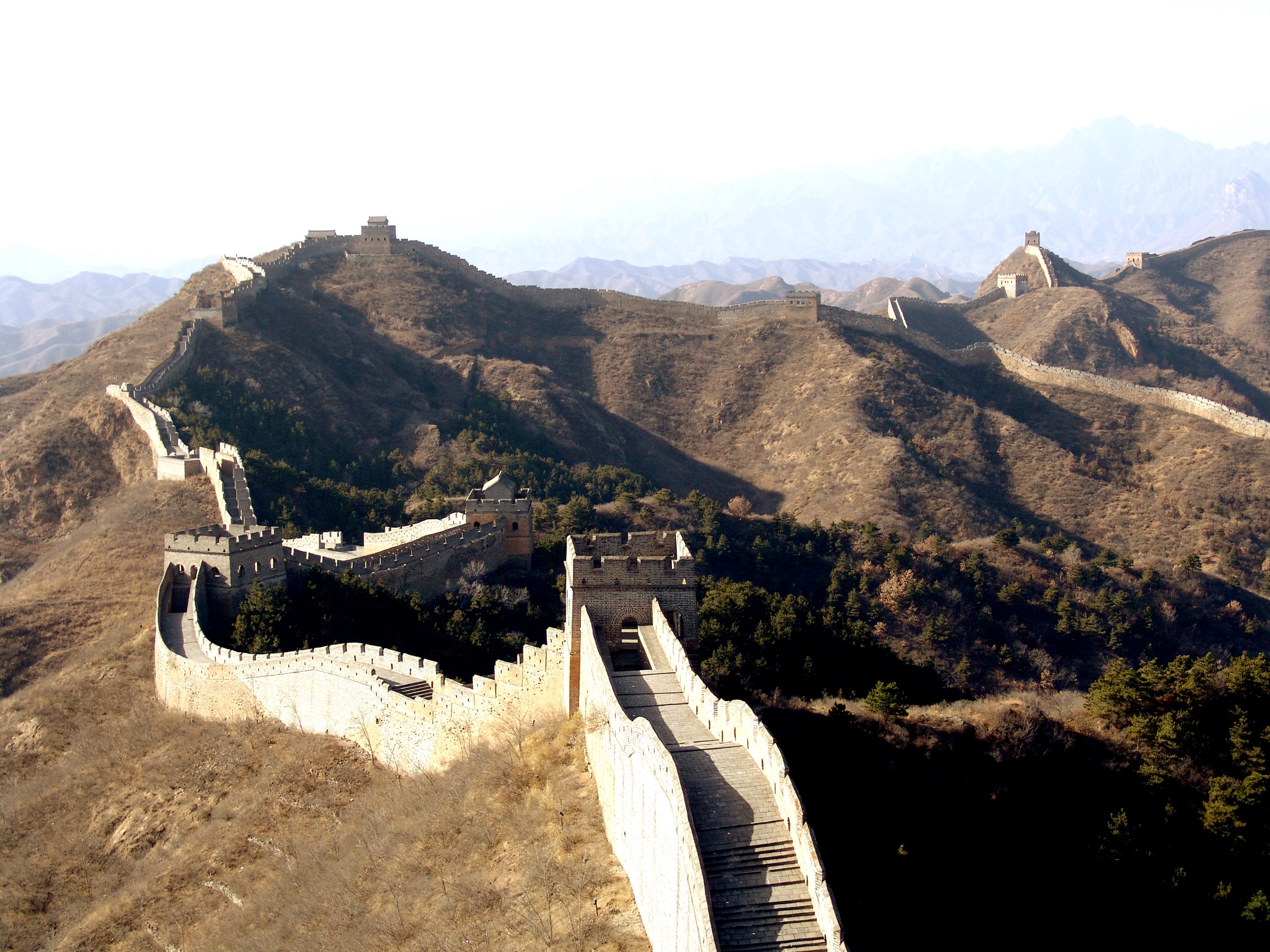
 The Great Wall of China
The Great Wall of China is a series of stone and earthen fortifications in northern China, built originally to protect the northern borders of the Chinese Empire against intrusions by various nomadic groups. Several walls have been built since the 5th century BC that are referred to collectively as the Great Wall, which has been rebuilt and maintained from the 5th century BC through the 16th century. One of the most famous is the wall built between 220–206 BC by the first Emperor of China, Qin Shi Huang. Little of that wall remains; the majority of the existing wall was built during the Ming Dynasty.
The Great Wall stretches from Shanhaiguan in the east, to Lop Lake in the west, along an arc that roughly delineates the southern edge of Inner Mongolia. The most comprehensive archaeological survey, using advanced technologies, has concluded that the entire Great Wall, with all of its branches, stretches for 8,851.8 km (5,500.3 mi). This is made up of 6,259.6 km (3,889.5 mi) sections of actual wall, 359.7 km (223.5 mi) of trenches and 2,232.5 km (1,387.2 mi) of natural defensive barriers such as hills and rivers
File:Greatwall-SA3.jpg
File:Great Wall at Simatai overlooking gorge.jpg
1.jpg
2.jpg3.jpg4.jpg5.jpg6.jpg 
 

Visit Us @ www.MumbaiHangOut.Org